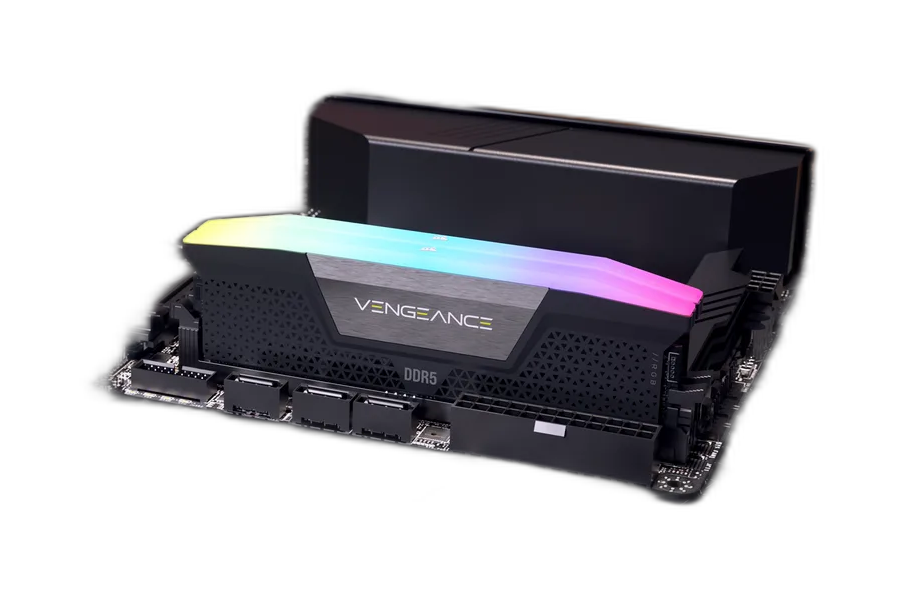
The Role of 16GB DDR5 in Modern Gaming
The PC gaming market is shifting toward 32GB as the new standard, but 16GB (2x8GB) DRAM kits remain a functional entry point for budget-conscious builders. While higher capacities offer more headroom for multitasking, current testing suggests that 16GB can still handle modern titles without significant performance degradation. This is particularly relevant as DDR5 pricing continues to influence total system costs for new builds.
Performance Benchmarks and System Impact
According to corsair.com, testing conducted with a Corsair Vengeance DDR5 CMH16GX5M2B5600Z40 kit revealed that 16GB of memory is sufficient for 1080p gaming at maximum settings. The test system utilized an AMD Ryzen 9 9950X3D processor and an X870E motherboard to eliminate other hardware bottlenecks. Even with background applications like Discord, Steam, the Epic Games launcher, and Chrome with five tabs active, the system maintained stable performance.
Key findings from the technical evaluation include:
- System memory usage typically hovered between 12GB and 13GB during 1080p gameplay.
- The RTX 4090 with 24GB VRAM handled the majority of the graphical workload, preventing the system DRAM from becoming a bottleneck.
- There were minimal differences recorded in average FPS and 1% lows when comparing 16GB to 32GB configurations.
- DRAM only becomes a primary performance constraint when the GPU's VRAM is completely exhausted.
While 32GB of DRAM offers more headroom, the actual difference in average FPS and 1% lows during gameplay was minimal.
— corsair.com
Capacity vs. Speed Trade-offs
Spec-wise, 2x8GB DDR5 These smaller kits are less common in the current market and generally do not reach the top speeds achievable by 32GB kits. For users prioritizing the absolute highest frequencies, the 16GB path may limit potential overclocking or peak bandwidth. However, for a budget-friendly build, the data confirms that the capacity itself does not inherently ruin the gaming experience.
Practical Value for Budget Builders
The choice between 16GB and 32GB often comes down to future-proofing versus immediate savings. While 32GB is the recommended standard for long-term stability, 16GB serves as a practical choice for those needing to allocate funds toward a stronger GPU or CPU. If you are gaming at 1080p and possess a GPU with sufficient VRAM, the performance loss is negligible in current titles.
16GB [is] a practical choice for a budget-friendly gaming build.
— corsair.com
Whether 16GB remains viable as games become more memory-intensive remains to be seen. For now, it stands as a functional option for entry-level DDR5 systems.