HoverAir has been busy expanding its specialized drone portfolio, shifting focus from urban environments to the open water. The company recently introduced a dedicated ecosystem designed for maritime activities, addressing the technical challenges of tracking and flight stability over aquatic surfaces. This new direction moves away from the standard optical sensors found in most consumer drones, which often struggle with the reflective and moving nature of water.
HOVERAir AQUA: A Specialized Flying Camera for Water Sports
The core of this new lineup is the HOVERAir AQUA, which the manufacturer describes as a fully waterproof flying camera. Weighing less than 249 grams, the device sits below the weight threshold that requires FAA registration for recreational use in the United States. This puts it in direct competition with other sub-250g drones like the DJI Mini series, though the AQUA differentiates itself through its environmental sealing.
The AQUA offers a maximum flight time of 23 minutes on a single battery charge. To accommodate various water sports, the software includes dedicated modes for kayaking, stand-up paddleboarding (SUP), and foiling. Users can operate the drone through the HOVER X1 app with a range of up to 500 meters, or extend that range to 1 kilometer using a separate Beacon accessory.
Key technical features of the AQUA include:
- OmniTerrain System: Utilizes satellite signals to stabilize takeoffs from water surfaces.
- Turtle Flip: Allows the drone to right itself if it ends up upside down in the water.
- Versatile Flight Modes: Includes over nine patterns such as Dolly Track, Bird's Eye, and 360° Spin.
- Post-Flight Maintenance: Requires a fresh water rinse with the battery inserted to remove salt and sand.
The AQUA Lighthouse: Wearable RTK Control Hub
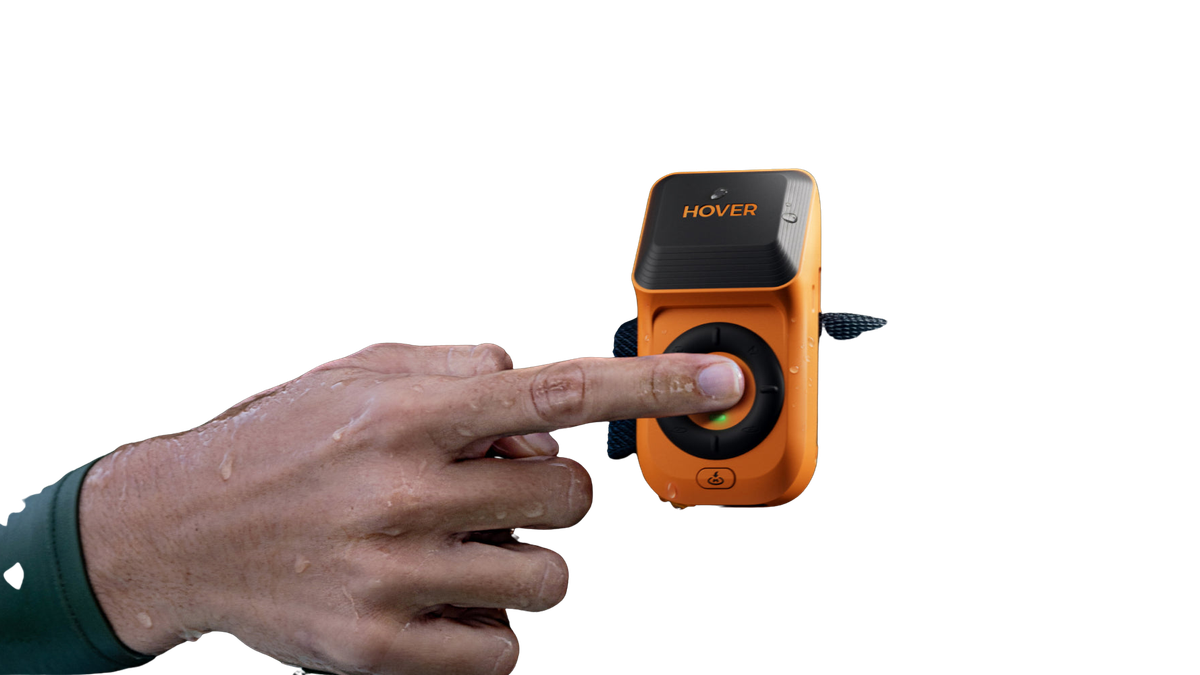
Beyond the drone itself, the company also launched the HOVERAir AQUA Lighthouse. This wearable device acts as a control hub and tracker, designed to be worn on the arm to eliminate the need for a smartphone during active water sports. It uses centimeter-level RTK (Real-Time Kinematic) technology to maintain a precise link between the pilot and the aircraft.
The Lighthouse functions as a "Virtual Tether," ensuring the drone remains within a preset range. If the AQUA drifts too far, the system automatically flies it back toward the user. This is particularly useful in environments where traditional GPS might have a higher margin of error. The device provides an operating range of 100 to 300 meters over open water.
On a different front, the Lighthouse serves as a remote interface with physical buttons. These controls allow for real-time adjustments of the camera angle, altitude, and distance. In the event of a connection loss, the drone is programmed to return to the last known location transmitted by the Lighthouse. The unit is waterproof and charges via a USB-C port, which must be sealed before entering the water.
Precision Tracking and CoPilot Functionality
The company is also making waves with its Precision Tracking system integrated into the Lighthouse. This hardware-software combination keeps the drone locked on the target even if the line of sight is temporarily obstructed. Unlike many consumer RTK systems, the Lighthouse does not require a static base station or a subscription to a third-party service provider.
The 'CoPilot' function within the Lighthouse allows for manual overrides while the drone is in an automated follow mode. This gives the user the ability to orbit or change height without landing the craft or accessing a mobile app. These features aim to solve the common problem of drone loss or "fly-aways" caused by the lack of visual contrast on the surface of the ocean or lakes.
The introduction of the AQUA and Lighthouse marks a shift toward category-specific hardware in the consumer drone market. While standard drones offer more general versatility, HoverAir's focus on waterproofing and RTK tracking targets a specific niche of outdoor enthusiasts. As these units begin to reach users, the effectiveness of the OmniTerrain system compared to traditional optical flow sensors will determine if this specialized approach becomes a standard for marine videography.