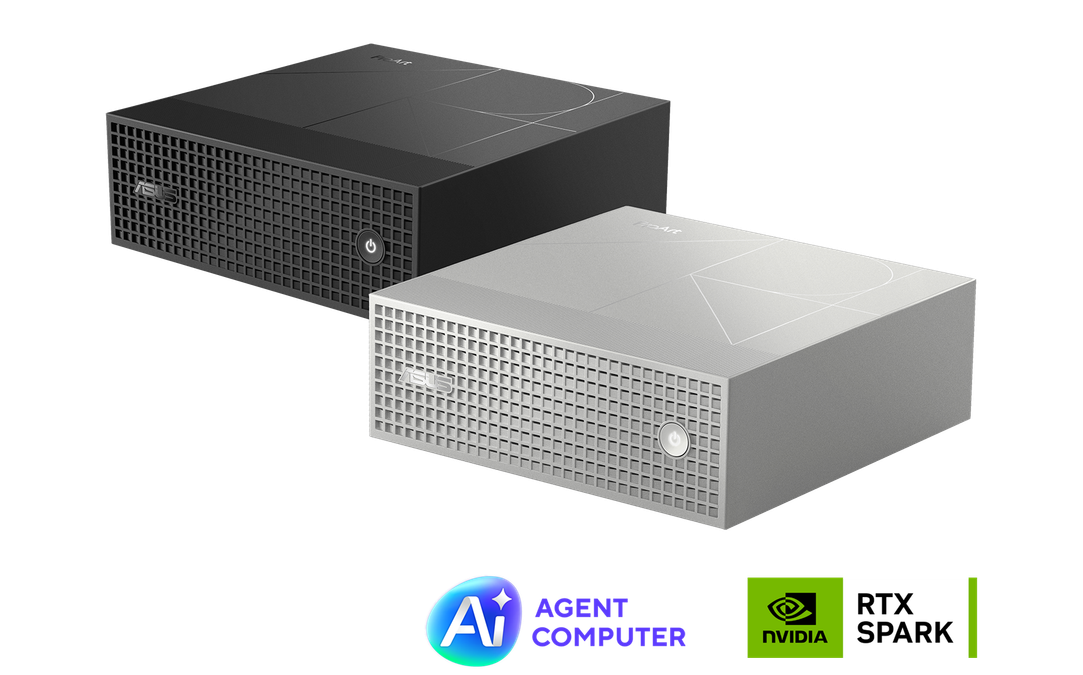
ASUS has been busy expanding its hardware and software footprint, moving from compact creative tools to massive data center deployments. The company is positioning itself as a primary provider for the "agentic AI" era, where local devices and cloud servers work together to handle complex autonomous tasks.
ProArt GR1X: A 1.1-Liter Powerhouse for Creators
The defining visual of the new ProArt GR1X is its incredibly small footprint. ASUS has managed to fit a 20-core Grace CPU and a 6,144-core Blackwell RTX GPU into a 1.1-liter chassis that measures just 150 x 150 x 51mm. Despite weighing only 1.48kg, the system is designed for heavy lifting, providing up to 1 petaflop of FP4 AI performance.
To keep the 140-watt TDP in check, ASUS uses a specialized dual-fan system. According to the manufacturer, this setup includes 218 fan blades, 57 ultra-wide fins, and four heat pipes. This thermal management allows the device to run 24/7 as an agent host. Connectivity is equally dense, featuring:
- Four USB 3.2 Gen 2x2 Type-C ports and HDMI 2.1
- Support for four 4K displays or one 8K output
- 10GbE LAN, WiFi 7, and Bluetooth 5.4
- Dual M.2 NVMe SSD slots with PCIe 5.0/4.0 support
The device ships with validated workflows for ComfyUI and Adobe Creative Cloud, alongside ASUS-specific tools like MuseTree and StoryCube. Through a partnership with Nous Research, the GR1X also supports the Hermes Agent, an open-source autonomous agent.
The Agent Computer Initiative
Beyond individual hardware, the company also launched the ASUS Agent Computer initiative. This program aims to bridge the gap between local, cloud, and hybrid AI deployments. It covers a wide range of hardware, from DIY motherboards like the ProArt and ROG lines to enterprise-grade supercomputers. The ecosystem is designed to be hardware-agnostic, supporting NVIDIA GeForce RTX, AMD Radeon AI GPUs, and Intel Arc Pro AI Accelerators.
On the software side, ASUS is introducing Zenni Claw to make agentic AI more practical for daily use. The Multi-LM Tuner helps users deploy optimized large language models across various platforms, while the DisplayWidget Center acts as a bridge between physical screens and AI workflows. ASUS claims this initiative will help organizations better manage the Total Cost of Ownership (TCO) for AI infrastructure.
Scaling Up: NVIDIA Vera Rubin Shipments
On a different front, ASUS is significantly ramping up its enterprise shipments. The company announced it is increasing volume shipments of NVIDIA Vera Rubin NVL72 systems in Q4 2026. The flagship AI POD XA VR721-E3 is a liquid-cooled rack-scale architecture that integrates 72 NVIDIA Rubin GPUs and 36 NVIDIA Vera CPUs.
The manufacturing of these systems involves high-precision L10/L11 automation, utilizing automated optical inspection (AOI) to ensure reliability. ASUS also expanded its MGX portfolio with the XA P2N-E2 and the ESC8000A-E13P, the latter of which features NVIDIA RTX PRO 4500 Blackwell Server Edition GPUs. For storage, the company introduced the VS320D-RS26N enterprise platform and the OJ340A-RS60 for high-density object storage.
Unified AI Factory Blueprint at SC26
In related news, ASUS unveiled a unified AI Factory blueprint at the SC26 conference. This framework allows enterprises to build infrastructure tailored to specific workloads. The lineup includes servers powered by 6th Gen AMD EPYC 9006 processors, such as the RS700A-E14B-R16U, which supports PCIe 6.0 connectivity and up to 16 E3.S drives.
The company also showcased high-performance GPU servers, including:
- XA AM3A-E13: Integrating eight AMD Instinct MI355X GPUs
- ESC8000A-E13P: Supporting AMD Instinct MI350P
- Intel Xeon 6 Lineup:
ASUS even provided a look at future tech, previewing the ESC8000-E13P server based on the upcoming Intel Diamond Rapids processor and Intel GPU D-series. For edge environments, the PE3000N and PE6000G industrial systems offer localized compute power.
By spanning the range from 1.1-liter mini PCs to liquid-cooled server racks, ASUS is attempting to own the entire AI pipeline. Whether you are a creator running a local agent on a ProArt GR1X or an enterprise deploying a Rubin-based AI POD, the company's focus on "agentic" computing suggests a future where AI is integrated into every layer of the hardware stack.