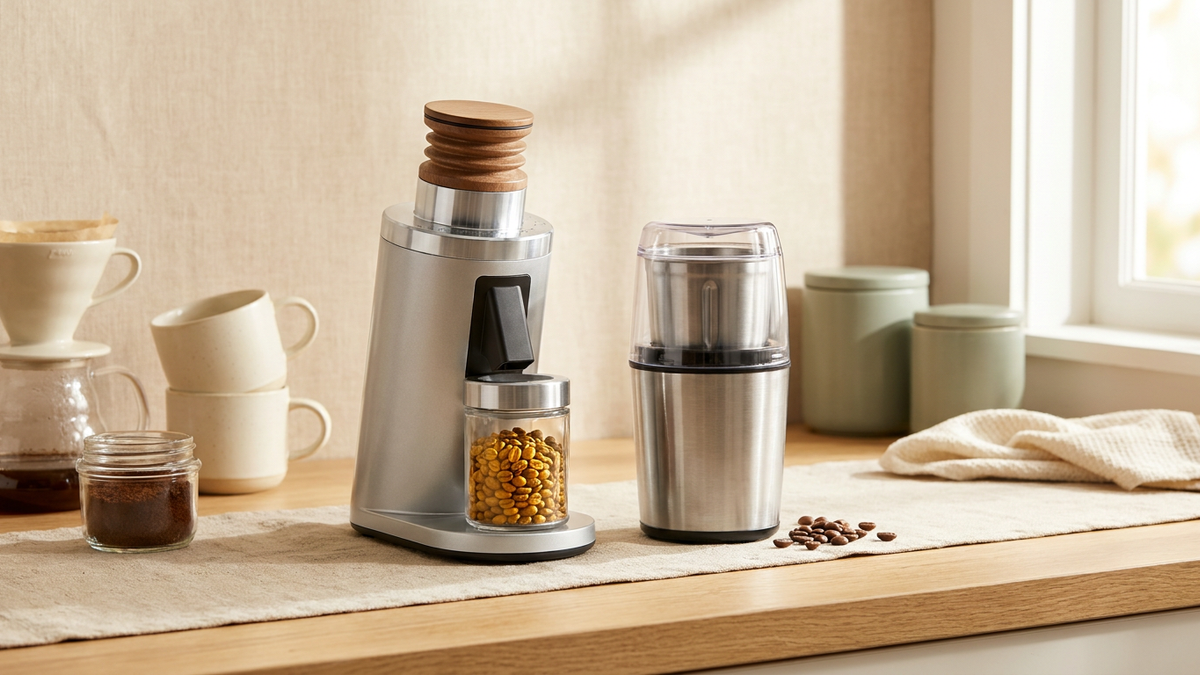
Burr vs. Blade: The High-Stakes Battle for Your Morning Cup
Investing in premium beans only to use a subpar grinder is like buying a sports car and filling it with low-grade fuel. In 2026, the gap between entry-level blade grinders and precision burr sets has widened as home brewing technology reaches new heights of accessibility. Achieving the perfect extraction depends entirely on particle uniformity, a feat that defines the core difference between these two technologies.
- Burr grinders produce uniform particles, leading to balanced extraction and superior flavor. - Blade grinders function like blenders, creating "fines" and "boulders" that cause bitter and sour notes. - For espresso and pour-over enthusiasts, a burr grinder is a non-negotiable requirement in 2026. - Blade grinders remain a budget-friendly option for casual drip coffee drinkers who prioritize speed over nuances.3 Myths That Mislead Buyers
- Myth: "Blade grinders are just as good if you pulse them." → Reality: Pulsing helps prevent heat buildup, but it cannot fix the physics of a spinning blade. You will still end up with a mix of dust and chunks, leading to uneven brewing.
- Myth: "Burr grinders are only for professional baristas." → Reality: Modern 2026 consumer models like the Hario grinder series are designed for home kitchens, offering user-friendly adjustments that anyone can master in minutes.
- Myth: "High RPM (speed) means a better grind." → Reality: High speeds generate heat that can singe the coffee's volatile oils. Slower, high-torque burr rotations preserve the delicate aromatic compounds of your beans.
The Mechanics of Extraction: Why Uniformity Matters
When water hits coffee grounds, it dissolves flavors at different rates based on the surface area of the bean fragments. In 2026, we understand more than ever that espresso grind consistency is the foundation of a drinkable shot. If your grounds are uneven, the water will over-extract the tiny dust particles (making it bitter) and under-extract the large chunks (making it sour).
Blade Grinders: The "Blender" Approach
Blade grinders use a high-speed stainless steel wing to shatter beans. Because the beans hit the blade at random angles, the results are chaotic. This is acceptable for basic drip machines, but if you are learning how to maintain your espresso machine, you likely want a grind that matches the quality of your equipment.
Burr Grinders: The Precision Approach
Burr grinders utilize two abrasive surfaces (burrs) that sit a specific distance apart. The beans are crushed between them, and only particles of the desired size can pass through. This delivers a level of control that allows you to "dial in" your coffee, adjusting for humidity, roast date, and brewing method.
Conical burrs are generally quieter and retain less coffee inside the machine, while flat burrs are often preferred by high-end enthusiasts for maximum particle unimodality.2026 Comparison Table: Burr vs. Blade
| Feature | Blade Grinders | Burr Grinders |
|---|---|---|
| Consistency | ❌ Poor (Uneven) | ✅ Excellent (Uniform) |
| Heat Retention | ❌ High (Can scorch beans) | ✅ Low (Preserves flavor) |
| Adjustability | ❌ Limited (By time) | ✅ Precise (Stepped or Stepless) |
| Price Range | $15 - $40 | $50 - $500+ |
| Best For | Basic Drip / Spices | Espresso, Pour-over, French Press |
Top Recommended Grinders for 2026
Choosing the right tool depends on your budget and your preferred brewing style. Here is how the leading options stack up this year.
Hario Skerton Pro (Manual Burr)
The 2026 edition of this classic manual grinder remains the gold standard for travelers and budget-conscious enthusiasts. It offers ceramic burrs that don't rust and a sturdy handle for easy cranking.
Pros
- Affordable entry into burr grinding
- Portable and requires no electricity
- Easy to clean and maintain
Cons
- Requires physical effort
- Slow for large batches
Baratza Encore ESP (Electric Burr)
This is the best all-around electric grinder for most homes in 2026. It bridges the gap between filter coffee and entry-level espresso, offering 40 distinct grind settings.
Pros
- Incredible versatility for all brew methods
- Replaceable parts for long-term sustainability
- Simple one-button operation
Cons
- Can be noisy during operation
- Plastic housing feels less premium
Proper maintenance is just as important as the grinder itself. Just as you would clean your coffee grinder to prevent rancid oil buildup, you should also ensure your other appliances are in top shape, much like following a 3D printer maintenance guide to ensure precision output.
Frequently Asked Questions
Is a burr grinder worth it for a standard drip coffee maker?Yes. Even in a standard drip machine, uniform grounds prevent the "muddy" taste often found in home-brewed coffee. You will notice a cleaner, sweeter profile immediately.
How long do burrs last before they need replacing?For most home users, steel burrs last for 500-1,000 lbs of coffee. In a typical household, this means 5 to 10 years of use before you notice a decline in grind quality.
Can I use a blade grinder for espresso?Technically yes, but the results will be frustrating. Blade grinders cannot produce the fine, consistent powder needed to create the necessary back-pressure in an espresso machine, usually resulting in a watery, sour shot.
When shopping for best coffee grinders 2026, look for "stepless" adjustment if you are serious about espresso. This allows for infinite micro-adjustments rather than being locked into pre-set clicks.Conclusion: Buy Now or Wait?
If you are still using a blade grinder or pre-ground coffee, the decision is simple: buy a burr grinder now. The improvement in your daily coffee quality provides a higher return on investment than almost any other kitchen upgrade. While blade grinders are sufficient for chopping spices or making a basic pot of diner-style coffee, they lack the precision required for the diverse specialty beans available in 2026. Start with a manual Hario if you are on a budget, or invest in a solid electric burr mill to future-proof your morning routine.