ASUS has been busy addressing high-end hardware stability while simultaneously expanding its portable productivity lineup. The company is currently managing reports regarding its premium motherboard performance under heavy loads and detailing new hardware for the mainstream laptop market.
ASUS Investigates Z890 Hero System Stability Reports
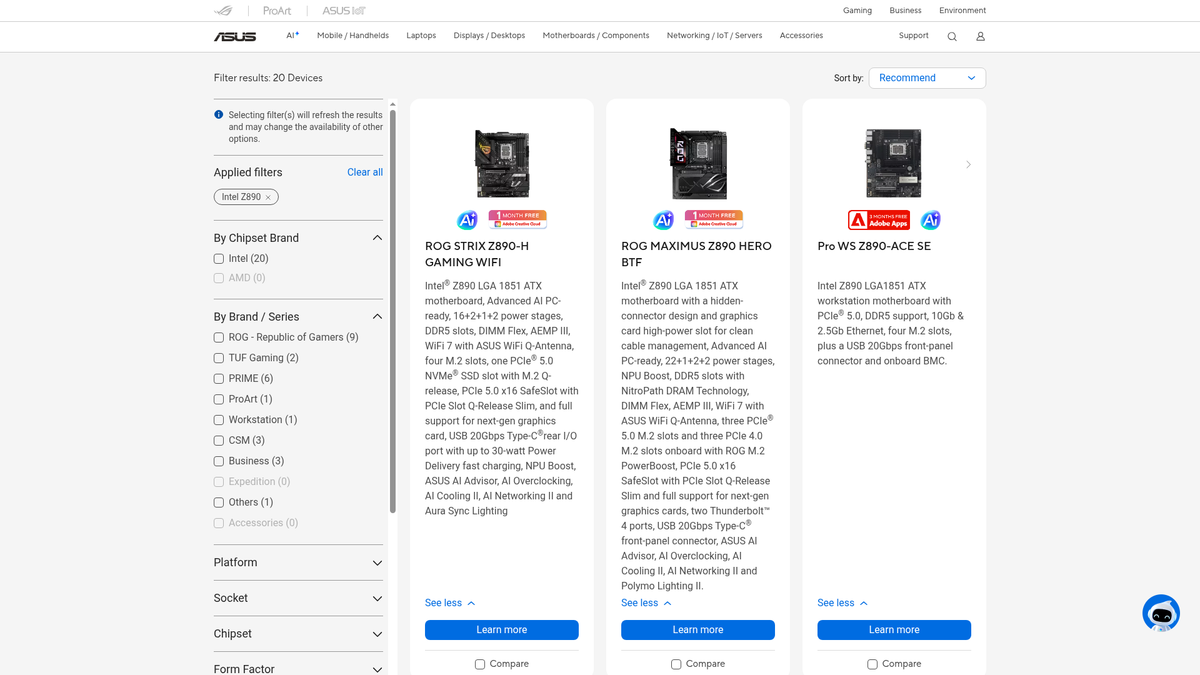
The high-end PC hardware market is seeing early reports of stability concerns involving the latest Intel platforms. An ASUS Maximus Z890 Hero motherboard, paired with an Intel Core Ultra 9 285K processor, recently experienced a sudden system reboot during an intensive gaming session. The failure occurred while the user was running Microsoft Flight Simulator 2024 at high detail settings for approximately two hours.
The system configuration involved in the incident includes:
- 96GB Corsair Vengeance DDR5 5600MHz RAM (XMP I profile enabled)
- ASUS TUF 5080 OC graphics card
- 1300W power supply unit
- Latest 3202 BIOS and Management Engine (ME) software
Following the crash, the system automatically prompted the user to enter the BIOS to check for hardware or configuration problems. While the user reported that most settings were kept at default, the incident highlights potential early-adopter challenges with the new Z890 chipset. This occurs in a competitive landscape where ASUS competes directly with MSI’s MEG series and Gigabyte’s Aorus Master for dominance in the enthusiast segment.
On a different front, ASUS is focusing on the mobile productivity segment by detailing the specifications for its latest large-format ultrabook.
ASUS Details Vivobook S16 (S5652) Specifications
The 16-inch laptop market continues to grow as users seek more screen real estate without the weight of traditional workstations. ASUS has released the full technical details for the Vivobook S16 (S5652), a device designed for home and office tasks. The laptop is powered by the Intel Core 7 Processor 350, offering speeds up to 4.8 GHz across 6 cores and 6 threads.
A notable addition to this model is the integrated Intel NPU, which delivers up to 17 TOPS for AI-accelerated tasks. This aligns the Vivobook with recent trends in the laptop industry, where manufacturers like Dell and HP are also integrating dedicated AI processing units in their mid-range offerings. The Vivobook S16 stands out with a 144Hz refresh rate on its WUXGA (1920 x 1200) IPS-level panel, a feature more common in gaming laptops than in standard productivity machines.
Key technical specifications for the Vivobook S16 include:
- Memory: Up to 16GB LPDDR5X on board RAM
- Storage: Up to 512GB M.2 NVMe PCIe 4.0 SSD
- Durability: US MIL-STD 810H military-grade certification
- Weight: 1.50 kg (3.31 lbs) with a thickness under 1.7 cm
- Battery: 52.5WHrs 3-cell Li-ion with a 48W Type-C adapter
Connectivity options are standard for the modern era, featuring two USB 3.2 Gen 1 Type-C ports with power delivery and display support, alongside two Type-A ports and HDMI 2.1. Potential buyers should note that the hardware drivers for this specific model are only compatible with Windows 11 version 24H2 or later versions of the operating system.
The company is also making waves with its commitment to durability in the thin-and-light segment. The MIL-STD 810H certification suggests that the Vivobook S16 is engineered to withstand more environmental stress than typical consumer laptops. This move places pressure on competitors to offer similar build quality in the sub-$1,000 price bracket.
As ASUS navigates these two different ends of the computing spectrum, the focus remains on refining the stability of its enthusiast-grade motherboards while providing feature-rich options for mobile users. The performance of the Z890 platform in long-term gaming scenarios and the market reception of the AI-capable Vivobook S16 will likely shape the company's strategy in the coming months.